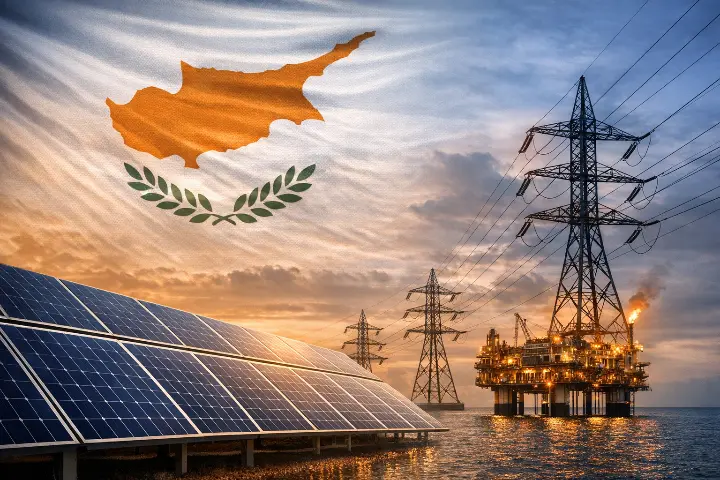
Cyprus’ economy is no longer just about tourism and real estate — it’s quickly evolving into a strategic player in the Eastern Mediterranean energy landscape. In 2026, energy investment, market reforms, and new infrastructure plans are driving discussion across business circles, government strategy and international partnerships. What does this mean for the economy, residents, and investors? Let’s explore.
1. A Strong Economic Foundation in 2026
Despite global volatility, Cyprus’ economy remains robust. Latest forecasts show the island continuing to grow, with unemployment stabilising and the labour market strengthening. The Central Bank highlights positive momentum with sustained employment and manageable inflation, even as challenges remain beneath the surface.
This environment provides fertile ground for energy sector investments — both domestic and foreign.
2. Foreign Investors Eye Energy Opportunities
In recent months, Arab states — especially Gulf countries — have shown strong interest in investing in Cyprus’ energy sector. These discussions have been a priority for the government, and they underscore Cyprus’ appeal as a stable, pro-investment economy.
This interest isn’t just anecdotal: strategic talks, partnerships, and diplomatic engagement are paving the way for real capital flows into local energy projects.
3. Transition to a Competitive Electricity Market
One of the most significant developments in the last year has been the liberalisation of Cyprus’ electricity market. As of October 2025, the monopoly held by the traditional utility ended, allowing numerous producers — including renewable energy players — to enter a competitive market.
This shift has multiple implications:
-
More choices for consumers — historically tied to a single provider
-
Competitive pricing and service innovation
-
New business opportunities for renewable and flexible energy players
It’s a structural upgrade that paves the way for long-term private investment and broadens the market beyond traditional incumbents.
4. Energy Infrastructure: Linkages & Regional Role
Cyprus has another strategic asset emerging: regional energy connectivity. Recent policy discussions highlight plans for electricity interconnections — such as potential links with Greece — that would strengthen energy security and reduce costs over time.
While these projects are long-term (often extending into the late 2020s), they represent a shift in economic strategy from energy import dependency toward regional integration and influence.
5. Natural Gas Prospects: From Consumer to Producer
Perhaps the most headline-grabbing development in recent years has been Cyprus’ progress toward becoming a producer of natural gas. The Kronos gas field — located offshore — is expected to start deliveries in the mid-late 2027 timeframe, potentially positioning Cyprus as an energy exporter in the Eastern Mediterranean.
This isn’t just geology — it’s geopolitics. Natural gas production can:
-
Enhance energy security
-
Attract multinational partnerships
-
Drive infrastructure investment
-
Increase state revenues and private business possibilities
For investors and businesses, these are signals of long-term economic transformation.
6. Renewable Energy: Progress and Growing Pains
Cyprus has made strides in renewable energy adoption, especially solar photovoltaics. However, challenges remain with effectively integrating renewables into the electricity grid. Studies show large proportions of clean energy — particularly solar — are being curtailed due to grid limitations.
This paradox — more renewable capacity but higher curtailment — highlights two important points:
-
Policy and infrastructure need to catch up with ambition
-
Energy storage and grid flexibility are next big investment frontiers
It’s one thing to install solar panels — it’s another to manage that power so it actually contributes to demand rather than being wasted.
7. Support Schemes and European Funding
Cyprus is also utilising EU programmes to support green investments. Multimillion-euro funds under the THALEA 2021–2027 cohesion policy are actively financing sustainable energy projects — from universities to schools and households.
Such funding not only accelerates renewables but also lowers barriers for private investors and entrepreneurs to participate in energy solutions.
8. Economic Impact: What It Means for Cyprus
The combined effect of these trends — market liberalisation, foreign interest, infrastructure development, and renewable expansion — is transformational in several ways:
? New Business Opportunities
Energy export infrastructure, storage solutions, smart grids, and clean technology services are opening up new sectors beyond traditional industries.
? Investment Appeal
International capital, especially from Gulf states and Europe, is signalling confidence in Cyprus’ economic direction.
⚡ Jobs & Skills
High-technology energy projects demand specialised labour, potentially increasing high-value employment opportunities.
? Strategic Importance
Cyprus is not just a passive consumer of energy anymore — it’s positioning itself as a hub connecting Europe, Middle East and North Africa markets.
These changes align with broader economic narratives that place energy at the core of future growth — not just for GDP, but for sustainable and strategic diversification.
9. Challenges to Watch
No transformation is without friction. Key concerns include:
-
Grid flexibility and infrastructure upgrades
-
Balancing renewable adoption with reliability
-
Ensuring fair competition in a newly liberalised market
-
Managing public expectations around price and energy security
These require thoughtful regulation, long-term planning, and public-private collaboration.
Conclusion: Energy Is the New Growth Frontier
2026 could well be the year that Cyprus’ energy sector shifts from promise to reality. With market reforms, foreign capital interest, infrastructure strategy, and renewable focus gaining real traction, the island’s economic narrative is evolving.
For investors, developers, and entrepreneurs, this means:
-
New markets to explore
-
Emerging asset classes
-
Strategic positioning in regional energy value chains
At Diaco Real Estate, we’ll continue monitoring how these trends influence everything from corporate investment trends to property valuations — especially in commercial, industrial, and grid-adjacent development zones.